Disaster Rally

  • Natural Disasters
    • Earthquakes
    • Hurricanes
    • Tornadoes
    • Fires
    • Floods
    • Tsunamis
    • Other
  • Man-Made Disasters
    • Nuclear
    • Pollution
    • War
    • Other
  • Prepare
    • Plan
    • Supplies
  • Disaster Resources
    • Agencies
    • Aid
    • Medical
    • Rescue
    • How To Help
    • People in need
  • Contact
  • About Us: Disasterrally

5 Facts about the Hurricane Katrina Storm Surge

Many people remember seeing the images of the Hurricane Katrina storm surge rage through New Orleans several years ago while watching the TV from the comfort of their homes. This event took place on August 29, 2005, and it is among the most damaging and deadly events of its kind. While many watched the events unfold on TV, many others lived through the event firsthand. As publicized as this event was, many people are not fully aware of the actual facts surrounding the Hurricane Katrina storm surge. By analyzing the facts of the event, you may gain more insight about what actually happened.

Hurricane Katrina Storm Surge Facts
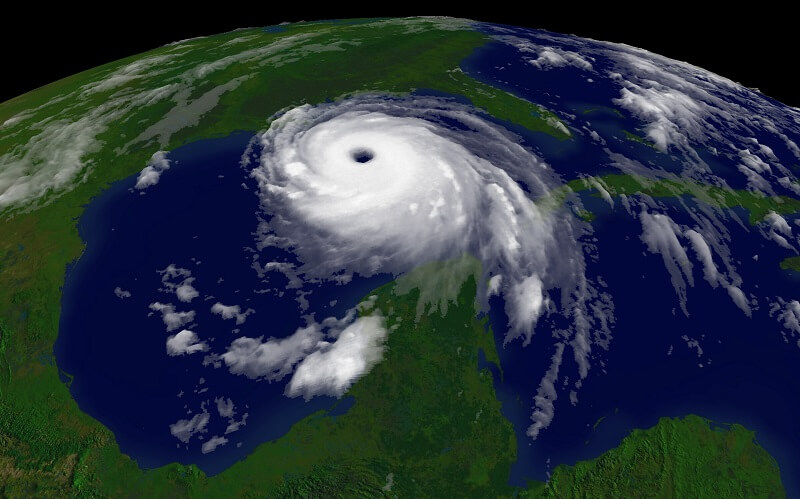
Hurricane Katrina
Image Source: Wikipedia

A Mandatory Evacuation Order Was Issued for New Orleans

The day before the Hurricane Katrina storm surge hit New Orleans, the city’s mayor, Ray Nagin, issued a mandatory evacuation order. This was the first mandatory order of its kind. Approximately 80 percent of the city’s population had followed the mayor’s instructions and had evacuated by the evening hours. He also set up the Superdome as a refugee area for those who could not leave the city. With a population of close to 500,000 residents, approximately 112,000 could not gain access to a car. This included the disabled, elderly and impoverished citizens. However, only 10,000 initially sought refuge in the Superdome. Most others decided to remain in their homes despite the mandatory evacuation order.

The Storm Surge Was Intense and Rapid

The hurricane initially hit the coast of Louisiana early in the morning on August 29. You may be aware that the levees that kept storm surges out of the inhabited areas were breached during the Hurricane Katrina storm surge. You may not be aware that by only 9 AM that morning, many of the levees had been breached, and water was rapidly surging into the area.

Many miles from the coastline, the water level was so high that residents who decided to remain in their homes had to climb on top of the roofs of their home. In fact, it is estimated that more than 80 percent of the area was under water by this time. The residents who remained in their homes essentially were trapped and urgently needed help from first responders.
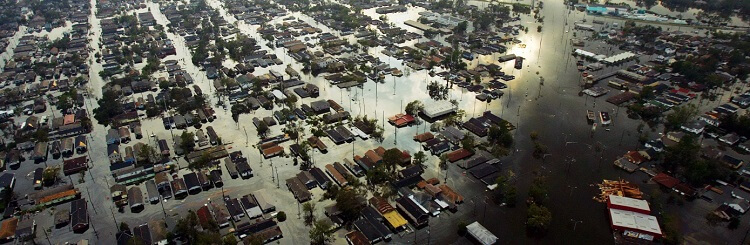
Hurricane Katrina storm surge flooding
Image Source: History.com

The Storm Weakened before Hitting Louisiana

Hurricane Katrina rolled through the Gulf Coast during a very active hurricane season. The hurricane originally struck Florida on August 26 as it made its way into the Gulf of Mexico. At that time, it was a weak Category 1 hurricane. It caused two deaths in Florida and moderate property damage.

Because of how active the hurricane season was, this hurricane did not initially receive much attention. However, Hurricane Katrina stalled in the Gulf of Mexico. As it churned, it grew to a massive Category 5 hurricane on August 28. On that day, the National Weather Service stated that there would be tremendous damage throughout the Gulf Coast region and that many areas may be uninhabitable for days.

The storm actually weakened to a Category 3 hurricane before it hit New Orleans head on. While the hurricane damage was moderate, the real impact of the storm came from the devastating Hurricane Katrina storm surge that took place because the levees broke.

The Death Toll Could Have Been Much Worse

Hitting the coast as a Category 3 hurricane, the storm weakened quickly. Within six hours, it was downgraded to a tropical storm. However, the aftermath of the storm was chaotic and deadly. Approximately 1,833 people lost their lives because of this hurricane. The storm surge was as high as 28 feet in some areas.

As deadly as this storm was, it is important to note that it could have been much worse. For example, the storm increased in size rather quickly, and the mayor acted rapidly to issue the mandatory evacuation order. The majority of the city’s residents followed the order. If these two factors were not in place, the death toll may have been exponentially higher. Furthermore, if the storm had struck land as a Category 5 hurricane and if it had not weakened so quickly, the devastation may have been much more significant and widespread.
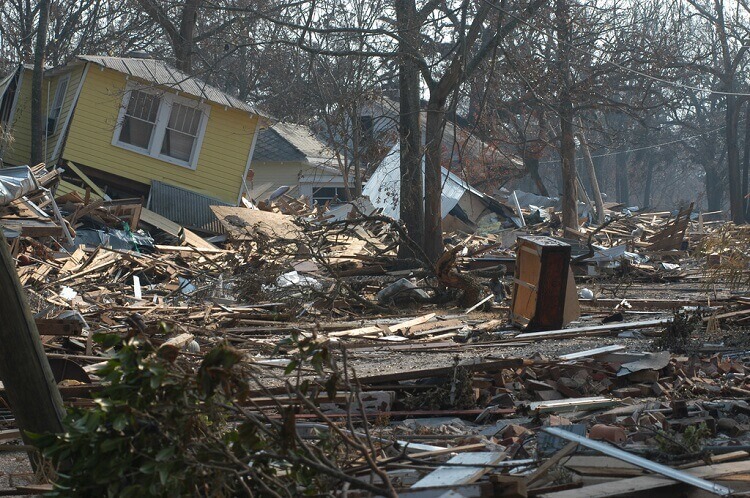
Houses destroyed by Hurricane Katrina
Image Source: FEMA.gov

The Controversy Surrounding the Hurricane Continues

While this storm hit ground more than a decade ago, many people still feel its effects and hold resentment over certain aspects of the event. For example, the levees were breached because of incompetence by the Army Corps of Engineers that built them. Furthermore, everyone from the FEMA director to the national, state and local governments were criticized for responding slowly in providing assistance to the victims. There was even an investigation into the matter by the U.S. House of Representatives, and they ultimately determined that there was a failure of initiative in this matter.

While more than 300,000 residents have moved away from New Orleans since the hurricane, the city has improved in many areas. For example, new levees have been built that are now taller; they are implanted as much as 65 feet into the ground for stability. There are also better plans in place to assist with removing the elderly and disabled from the city when an evacuation is issued. Nonetheless, the city continues to be rebuilt, and as long as signs of the devastation remain, the controversy surrounding the storm remains.

Summing Up

When a devastating event such as the Hurricane Katrina storm surge hits, mass casualties often cause people to point fingers. However, it is important to note that there was a huge relief effort that continued on for years to help the victims of this tragedy. This includes an initial response from the American Red Cross, the Coast Guard, FEMA and others. It also includes FEMA housing and relocation assistance for those who needed long-term support after the incident. Some are continuing to rebuild their lives, and the lessons learned from this event may prevent future tragedies from occurring.
What to Do if Caught in Severe Storms: Essential Survival Tips

Severe storms come in all shapes and sizes, so it’s no surprise that people get confused about the safest course of action. What’s good for one severe storm situation isn’t always good for the next.

This article will explain the safest courses of action for the most common types of severe storms: floods, hail, lightening, high winds and tornadoes, and blizzards. You are often faced with several of these emergencies at once, but if you know what to do in each situation, you can keep your cool and find a safe place to ride it out.

5 Types of Severe Storms and How to Stay Safe

Flooding

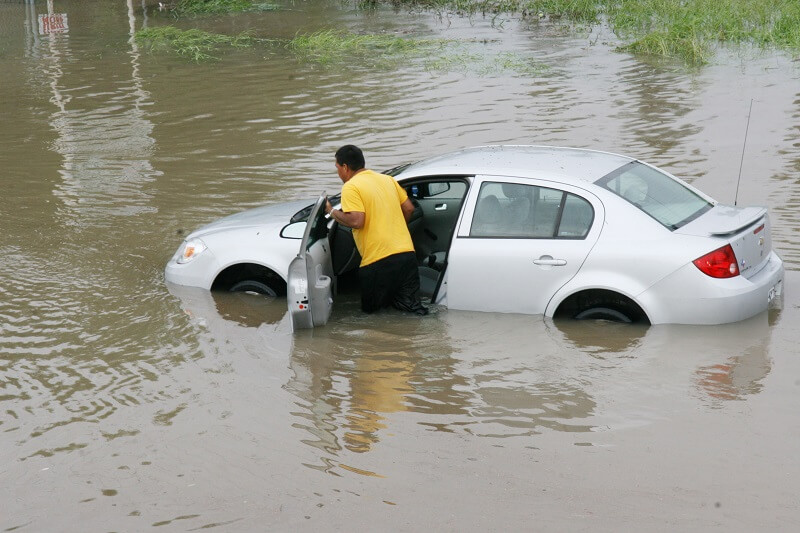
man pushing his car through flood waters
Image Source: Wikimedia Commons

Flooding killed 126 people in 2016 alone. It is by far one of the most dangerous consequence of severe storms that a human can face, and also one of the most preventable causes of death. This is because most flooding deaths occur when a driver tries to move through shallow water and is swept away. The truth is that it only takes 18 inches of water to carry away a small car. Once you are in deeper water, you’re at great risk of drowning because flood water flows so fast it’s like trying to swim through a riptide.

If you are in this situation:

  • Remain calm.
  • Immediately unlock your doors.
  • Remove your seat belt and roll down your windows.
  • If you are wearing a heavy jacket, remove it because it will make it harder to swim.
  • Climb out through the windows if you can and get to high ground.

If you can’t open your windows, you must wait for the car to fill with water to open the doors. Don’t waste your energy trying to open the doors before the water pressure equalizes. You will need that energy to swim. Instead, stay very calm, look for the nearest safe location to swim to. Take a very deep breath at the last minute and push hard on the doors, they will open when the water pressure has equalized.

Hail

how hail looks like
Image Source: Wikimedia Commons

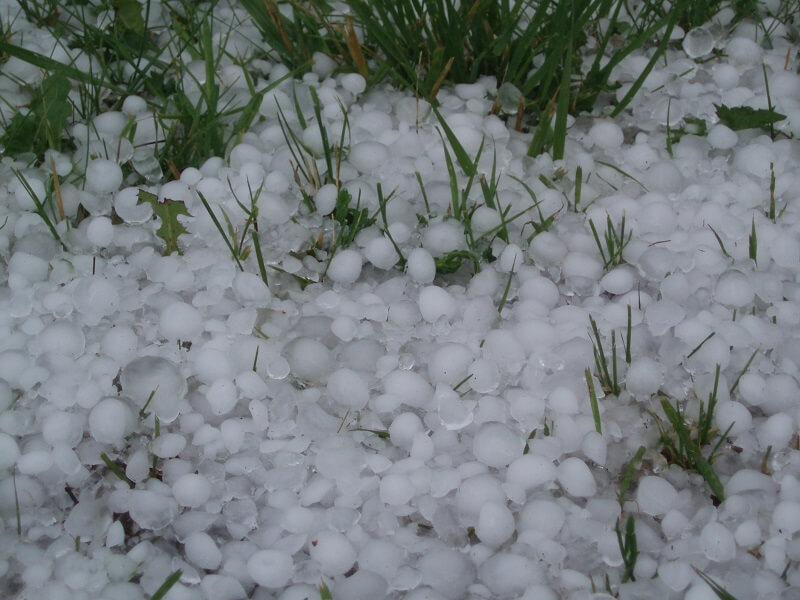
Hail can reach near 100 mph by the time it hits the ground. That means that even small hail can kill if it hits your unprotected head. So, during severe storms, make sure you find shelter before the hail starts. If you are in a building, stay away from windows as sideways falling hail can shatter them and injure you severely.

If you are out in the open with no better shelter, get in your car. DO NOT try to shelter under a lone tree as it will draw lightening. A stand of several trees can be safer if there is no other option. If you are in an open field without even this possibility, get down on the ground in a crouching or fetal position and cover your head and the back of your neck to protect them. Shield your spine as well, even if you can only do so by lying on your side with your hands over your face and neck.

Lightning

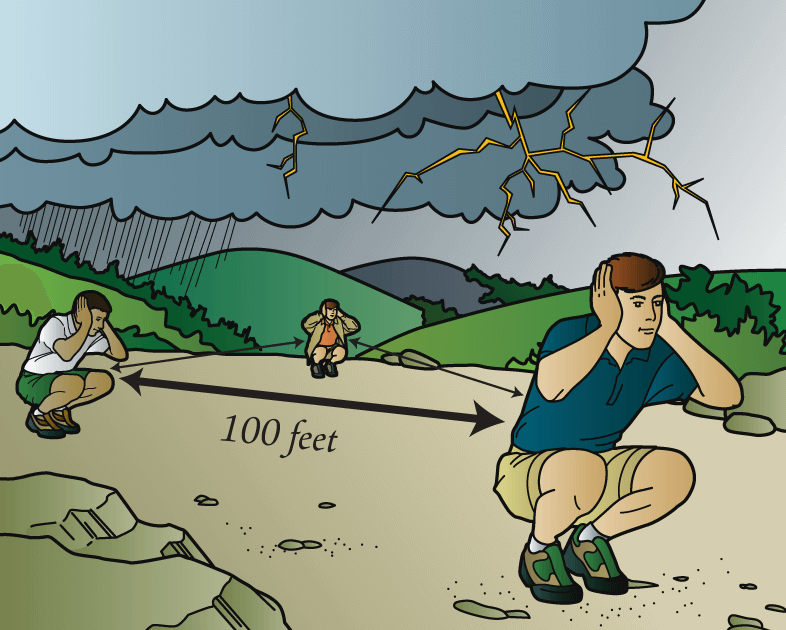
how to crouch in the lightning strike safety position
Image Source: Outdoors.StackExchange.com

Believe it or not, you can survive a lightning strike, but the best bet is not to get hit in the first place. The obvious is to seek shelter immediately when the storm approaches and wait inside until 30 minutes after you year the last sound of thunder. Lightning can travel for miles.

If you are caught in the open, DON’T hide under a lone tree. If you can hide in an area that is lower than and near to but not too close to a dense growth of trees, this can help, but never hide near a tall isolated object. Also, don’t lie flat on the ground. It just increases surface area for damage.

Instead:

  • Move away from anything metal so you aren’t touching it.
  • Crouch low as you can.
  • Lift up your heels so only the balls of your feet are touching the ground to minimize contact.
  • TOUCH YOUR HEELS TOGETHER (this helps the electricity to only arc from one foot to the other instead of entering your entire body).
  • Cover your ears with your hands to protect them from hearing loss.

Should the hair on the back of your neck stand up, you need to assume the above position immediately.

High Winds or Tornadoes

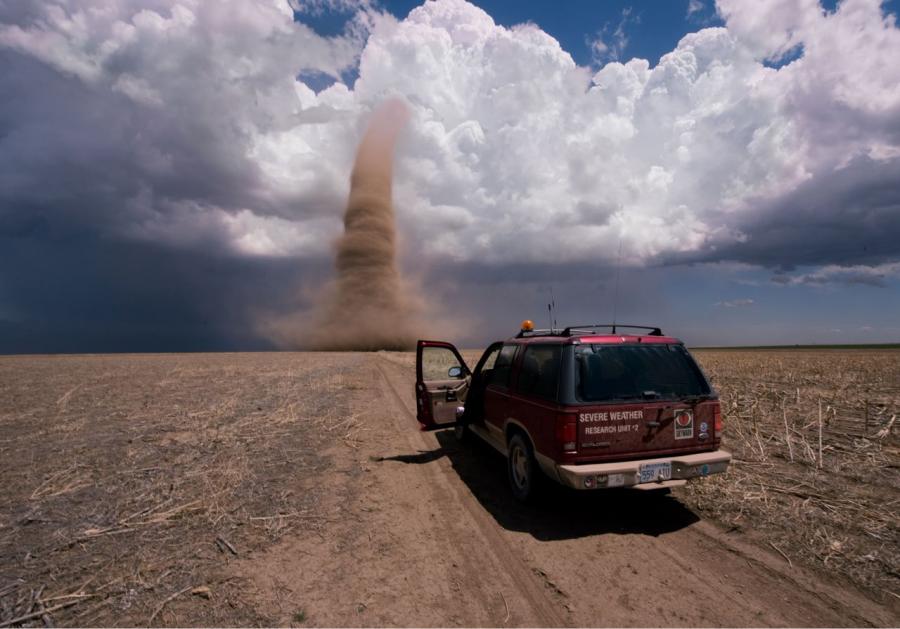
car facing a tornado
Image Source: Reliable-Remodeler

First, if caught outside during these types of severe storms, do not try to seek shelter under a highway overpass. As the wind is pushed through an overpass, it actually increases in velocity, which increases your chances of being swept away.

If you are driving and you can still safely drive, don’t try to outrun a tornado because they can travel at 70mph, which is not a safe speed to drive in a severe storm. Instead, if you are still safely driving, angle away from it at 90 degrees.

If the storm is catching you, you need to exit the car and find shelter. If none is available, you should lie in a ditch as far away from trees, cars and large objects as possible. Protect your head and spine in the same way as you would during a hail storm.

The same advice goes for high winds, AKA straight line winds, which can be almost as dangerous as a tornado. Straight line winds knock over cars and people, so if you are facing these, you need to lie flat in a ditch till they pass.

Blizzards

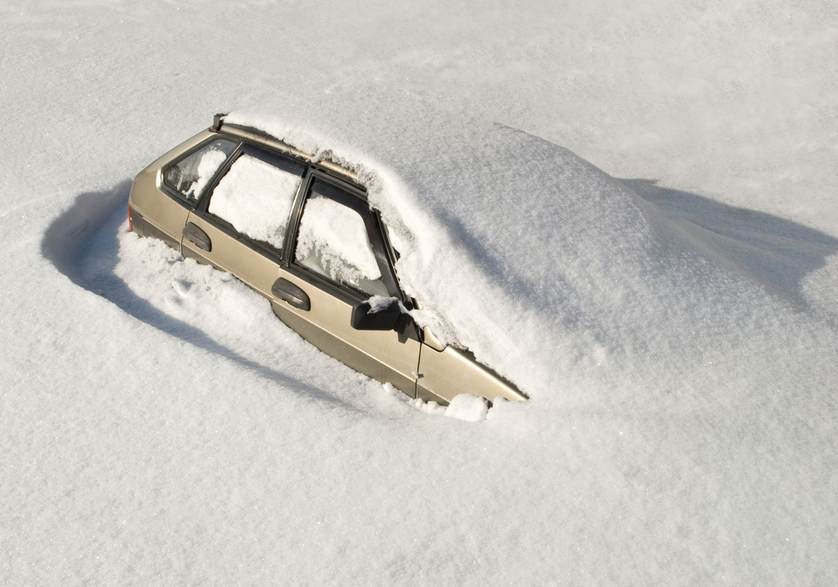
car stuck in snow after a blizzard
Image Source: SafeBee.com

Prevention and preparedness are key to surviving these types of severe storms. If you are caught in your car, turn off the engine to avoid carbon monoxide poisoning and break out your emergency kit which should include prepackaged snacks, water and lots of blankets, boots, gloves and coats. It should also have a well sealed container for melting snow in case you run out of water. You must stay hydrated to stay warm.

You can turn the engine on every few minutes to warm the car and keep it from locking up; just don’t run it continuously. If you are on the side of the road, keep your seat belt on and turn on your hazards. You can still be hit by someone else who is trying to drive through.

If you are not in a car, seek shelter out of the wind and keep moving to keep your body warm. Remember, hydration is the most important thing you will need in this situation. Your body can stay warm more easily if you are well hydrated.

A Word of Ending

These are only basic beginners tips for surviving severe weather. However, they cover the leading causes of death in each situation. All are a very good starting point that you should learn and memorize. The National Weather Service also has a great deal of information on this topic. Weather.gov is another great source. Ultimately, the way to survive severe storms is to stay calm, think clearly and take decisive action to protect yourself at the first sign.

Do you have any severe weather tips that you would like to share? Please comment below!

The 6 Types of Volcanoes and Their Characteristics

If you ask any K-12 teacher what the types of volcanoes are, they will be very quick to answer your question with the 3 volcano system: Shield, Cinder Cone and Composite Cone. There are those who make a very compelling argument however, that this system is far too limiting. “What about Yellowstone Caldera?,” they might ask. Oregon State University makes a very compelling argument that volcanologists would be much better served to classify volcanoes into 6 types instead of 3. Below is their proposed classification system, and the characteristics of each type.

The 6 Proposed Types of Volcanoes and Their Characteristics

Shield Volcanoes

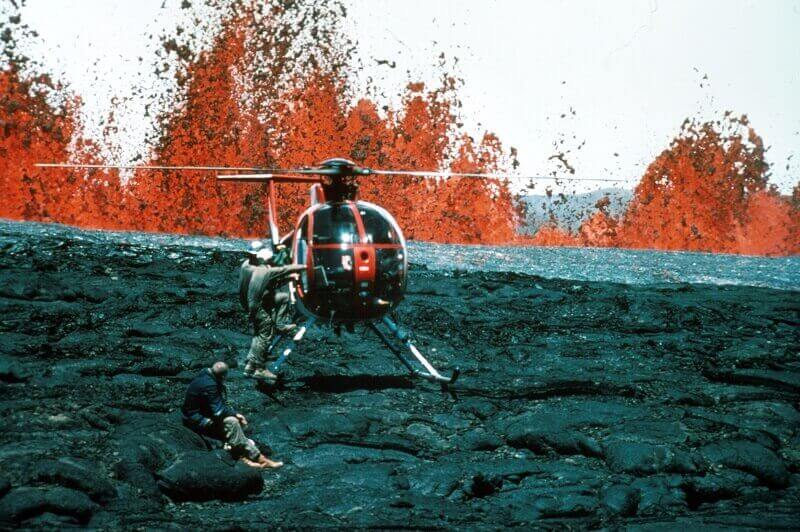
Mauna Loa shield volcanoe, one of the major types of volcanoes
1984 Mauna Loa Eruption

These types of volcanoes are considered the largest under the three volcano classification system. Under this system, they are just the largest ones that we would recognize with our eyes. Mount Kilauea and Mauna Loa (which is the largest among active volcanoes on our planet), are two of the most famous examples of these types of volcanoes.

Shield volcanoes are composed almost entirely of basalt, which is a type of volcanic rock that flows very fast in its lava form. This makes these types of volcanoes more shallow and wider, because the lava doesn’t have time to pile up on itself before it cools and solidifies into volcanic rock. They are also some of the gentlest volcanoes in our world, making mesmerizing fountains of lava at the eruption site that aren’t particularly explosive unless there is water present at the site of the eruption.

Stratovolcanoes

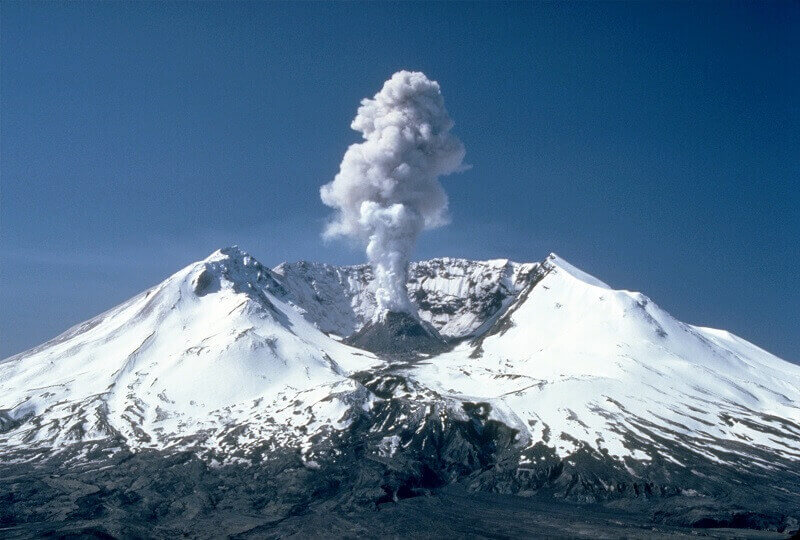
Mount St. Helens eruption
1982 Mount St. Helens eruption

Stratovolanoes are the most common types of volcanoes on the planet. They tend to erupt with lava that is thicker and slower flowing, enabling it to pile up to great heights. Of course, as the lava piles up, it tends to form a sort of plug that locks in dangerous gasses and pyroclastic materials that build up until the pressure becomes so great that it causes an explosive eruption. This is what makes these such dangerous types of volcanoes to be near during an eruption.

Even greater than the danger of projectiles falling from the summit, is the possible pyroclastic flow, consisting of noxious gasses that are heavier than the air and ashes that flow down the side of the volcano and inexorably smother anything in their path. Mount St. Helens is a famous example of a stratovolcano. An even more famous example is Mount Vesuvius, which caused the destruction of Pompeii.

Monogenetic Fields

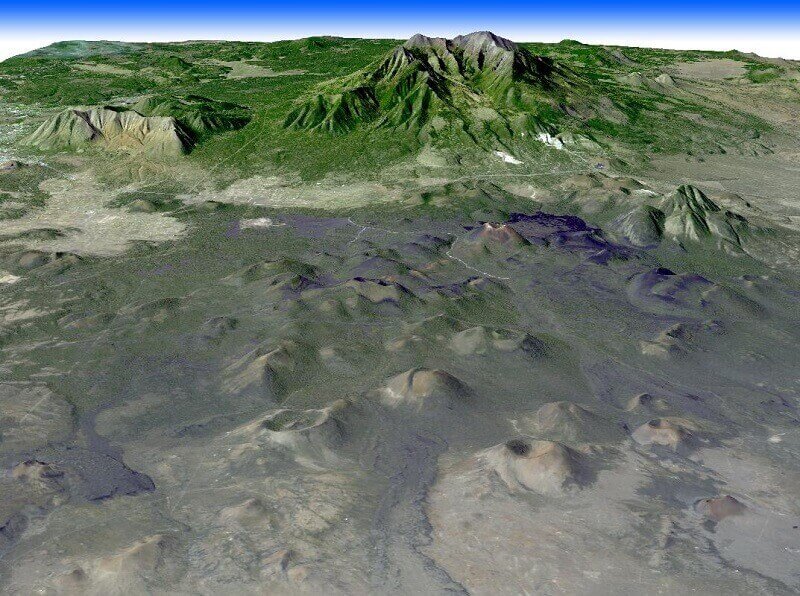
San Francisco Peaks Volcano Field
San Francisco volcanic field

Monogenetic fields are massive fields that contain hundreds or even thousands of volcanic vents. These types of volcanoes don’t look like volcanoes per se, but they are still volcanic in nature. The supply of magma is not nearly as forceful as it is with other types of volcanoes, so there is never a specific path for the magma chambers like you would see with a more traditional type of volcano. It seems that whenever they gently erupt, the magma finds a new path to the surface.

Believe it or not, America has quite a few of these types of volcanoes. One, called the San Francisco volcanic field has a misleading name. It’s actually in northern Arizona, just north of Flagstaff. There are also quite a few of these fields in Mexico.

Flood Basalts

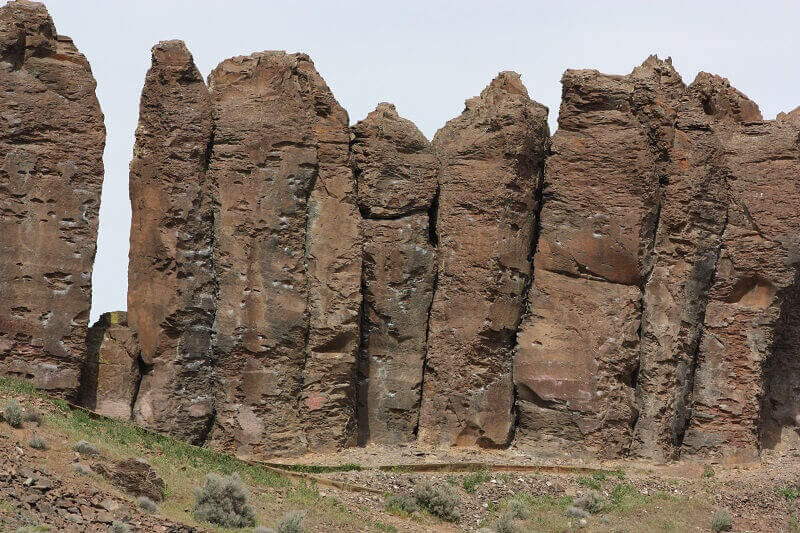
Columbia River Basalt Group
Columbia River Basalt

The Columbia River Basalt province that covers a large portion of south east Washington is one example of these types of volcanoes. They are remarkable areas on our surface that are covered with dozens of meters thick and hundreds of kilometers long flows of basalt.

Flood basalts are poorly understood, but scientists now think that the thin flowing basalt gets so thick in these areas because new magma is injected into the old, hardened magma that has already erupted and cooled from the site. Over time, the flow becomes thicker and thicker till it reaches epic proportions.

Mid-Ocean Ridges

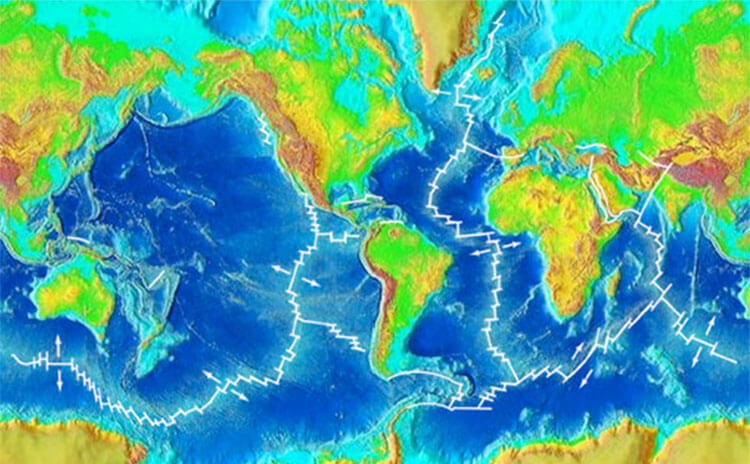
Mid-Ocean Ridges
Mid-Ocean Ridge system

Some scientist feel that the mid-ocean ridges are simple one, enormous, tens of thousands of kilometers long volcano. This is the part under the ocean where our tectonic plates pull apart and squish back together. As they do so, magma escapes from the crust deep under the ocean at the places where these plates clash and pull apart and build ridges of fresh basalt.
While we have never seen one of these eruptions (as they are not one of the easiest places on Earth to get to), we have seen the evidence of them shortly after small earthquakes at the edges of the plates, including super heated water, dead marine life in the area and fresh deposits of basaltic rock.

Rhyolite Caldera Complexes

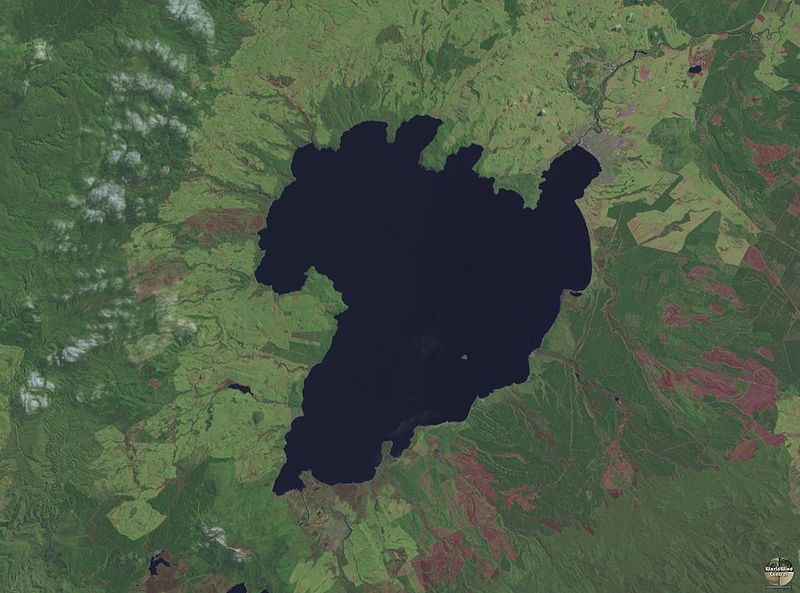
Lake Taupo satellite image
Lake Taupo caldera

In the year 83 AD, a massive eruption took place at north eastern Lake Taupo in New Zealand. It was the most massive eruption the world has seen in the past 5,000 years. The cause of this eruption was the incredible pressure building inside the magma vents under the Taupo caldera. The result was a devastating pyroclastic flow that destroyed 20,000 square kilometers of the island, not to mention an astounding ash cloud. Still, this is nothing compared to the devastation that scientists think the Yellowstone caldera is capable of producing.

These “super volcanoes” are more properly classified as rhyolite caldera complexes and they still are not fully understood by science. They don’t even look like volcanoes, but are instead the result of eruptions so massive that the land collapsed completely in on itself over the massive magma chambers that feed them. These eruptions cause calderas that can be hundreds of miles across. Thankfully, these incredibly destructive and fascinating types of volcanoes only erupt on the rarest of occasions.

Summing Up

It’s important to remember of course that all classification systems are subjective. The three volcano system leaves out the most important systems in our world, such as super calderas and the mid-ocean ridges. It would be hard to argue that these systems don’t affect our world.

Some simply classify volcanoes by whether they are dormant, active or reactivated. They authors of Volcanoes of the World, on the other hand, very thoroughly classify 26 types of volcanoes. This may be overkill to anyone but a volcanologist. This six type system seems to pretty well sum up the major types of volcanoes that affect our environment.

IMAGE SOURCE: 1, 2, 3, 4, 5, 6

The Five Major Types of Natural Disasters

There are five major types of natural disasters that humans face, depending on which part of the world they live in and what their environment is like. Each of these types of disasters has occurred before and will occur again. Some are so devastating that tales from their survivors last for centuries or even millennia. Theories are that the story of the great flood, which is knows in different versions throughout the world, was of a tsunami or rain induced flood so strong that it destroyed an entire continent.

5 Types of Natural Disasters and Their Effects

Geological

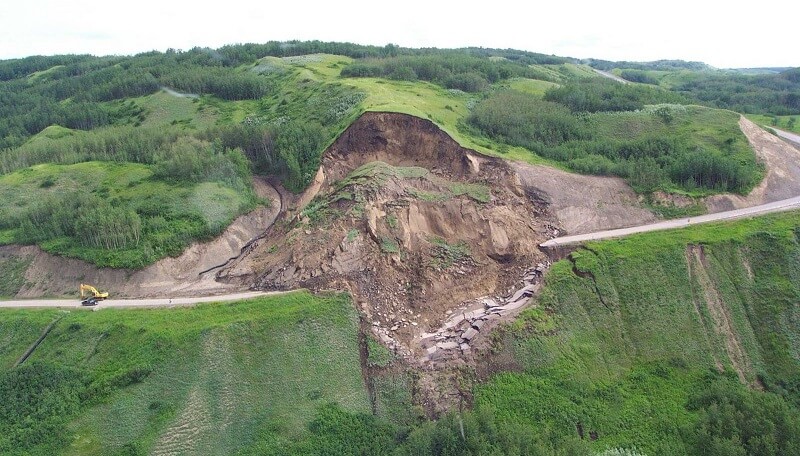
road affected by a landslide, one of the main types of natural disasters
Landslide
  • Landslides and avalanches. There are several different types natural disasters that cause landslides and avalanches, but they all have the same result. They bury anything in their path indiscriminately.
  • Volcanic eruptions. Volcanic eruptions cause death from falling debris, deadly gasses and lava flows. These types of natural disasters are the closest thing to hell on earth that one can experience. Yet, without volcanic activity our entire planet would die, so it’s a trade off for humanity.
  • Earthquakes. Some parts of the planet are more seismically active than others, but earthquakes can happen literally anywhere on the planet. Recently, the state of Oklahoma is seeing an uptick in earthquake activity that most scientists are now blaming on the practice of fracking for natural gas.
  • Sinkholes. Sinkholes just aren’t fair. They pop up out of no where without warning. One minute you’re sleeping in your bed and the next – bam – your entire house is under ground. This is what happened to Jeffrey Bush in Florida. His brother dried to save him, but Jeffrey was buried alive sixty feet under ground.

Weather

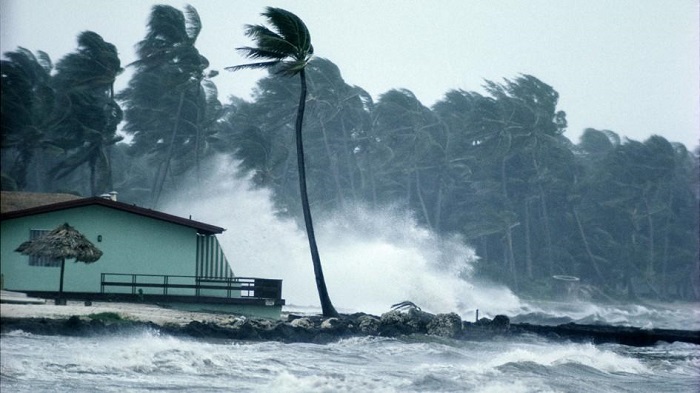
hurricane taking place
Hurricane
  • Thunderstorms. Thunderstorms are the types of natural disasters that usually just sound scary but do more benefit than good. But when these storms spout tornadoes, hail and extreme lightening, the consequences can be devastating.
  • Hurricanes. Hurricanes are a giant wall of natural disasters all wrapped up in one. They cause flooding, wind damage, lightening strikes, tornadoes and hail, all at once.
  • Blizzards. Blizzards are the worst snow storms that occur. They bring wind, ice and snow so deep it can bury entire houses and crush roofs under the weight.
  • Droughts. Droughts happen when rain falls far below what an area needs to maintain its normal environment. The worst dangers that happen with droughts are wildfires and subsequent famine as crops die.
  • Temperature extremes. Whether it’s way too hot or way too cold, each of these types of natural disasters can take a huge toll on live. Every year, hundreds of humans die from excess heat or cold. Animals tied up in back yards without protection fair even worse.

Hydrological

Tsunamis

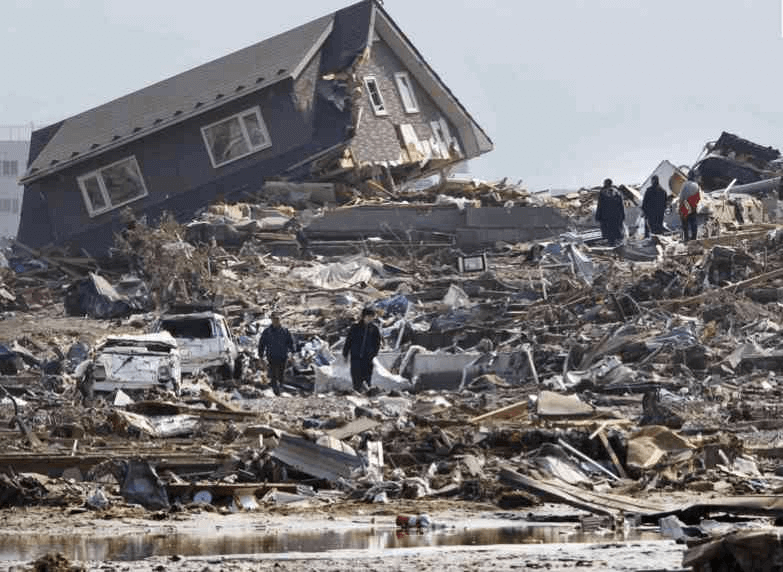
House devastated by a tsunami

Tsunamis can originate both in the ocean and very large lakes, and when they occur, they are one of the most destructive forces that water can create. These tidal waves can occur from earthquakes, eruptions, explosions, and even meteor impacts. The consequences of a tsunami can be incredibly far reaching, causing massive infrastructure damage. One of the worst examples of this is the damage caused to the Fukushima nuclear reactors in Japan following an earthquake and subsequent massive tsunami. The plant is still in melt down today.

Floods

Floods are one of our most common natural disasters. It can be caused from heavy rain, excessive snow melts, or even in a dry and sunny day when a dam or levee fails. The floods that occurred in New Orleans after Hurricane Katrina were not caused by the hurricane itself so much as by the failure of the city’s levee system. The disaster was made all the worse by the fact that the city is below street level. More recently, more than 200,000 people were evacuated from Northern California cities surrounding Oroville for fear that the crumbling infrastructure of the nearby lake’s levees would suddenly fail. Maintenance of such infrastructure is becoming a more serious concern as more communities are built in natural flood basins that depend on levees and dams for their protection.

Gas eruptions

Lakes look peaceful and relaxing, but they can be a source of one of the most deadly natural disasters known to man, the limnic eruption. Gasses such as CO2 can build up under the pressure of a large lake and then suddenly erupt from the bottom all at once. The resulting sudden and large release of the gas can suffocate all life in the surrounding area. These eruptions can be caused by explosions, underwater landslides or geothermal activity. In 1986, nearly 1,800 people suffocated from a limnic eruption in Lake Nyos, Cameroon.

Fires

firefighter against the wildfire

Wildfires are one of the types of natural disasters that can can inspire awe and fear in all. They can move so fast they they burn every living thing in their path alive before they have a chance to escape. This happened recently in the Midwest as a massive wildfire swept through the panhandle of Texas and parts of Oklahoma, Colorado and Kansas on wind gusts of 60 miles per hour. The cattle caught in the blaze were helpless to escape, with most being burned to death on the spot. Others, less lucky, were still alive when the ranchers found them.

Disasters from Space

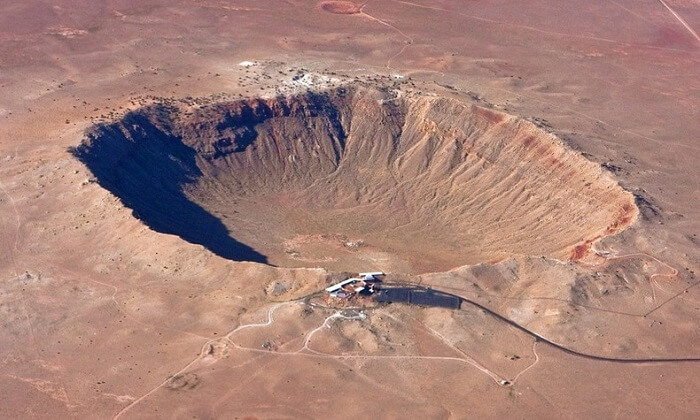
Meteor Crater, Arizona
  • Meteor impacts. This may sound like the backdrop of a bad science fiction movie, but these impacts can and do happen. It’s not a matter of if, but when. Even meteors that explode in the atmosphere can cause immense destruction. The 1908 Tunguska explosion in Russia was cause by a meteor that exploded in the upper atmosphere with the force 1,000 times stronger than the bomb that leveled Hiroshima. Had it occurred in a very populated area, the death count would have been huge.
  • Solar flares. Solar flares aren’t a problem unless they cause an eruption that is directed at the Earth. We become more vulnerable to damage from solar flares as we depend on the electrical grid for all aspects of our lives. This is because a strong enough flare can bring the electrical grid of an entire hemisphere down in a matter of minutes. Without power, there would be no way to fuel trucks to bring food supplies and medicines. Worse, there would be no power to keep our nuclear power plants from melting down.

No matter what types of natural disasters you may face, it’s best to prepare and have well-rehearsed contingency plan with your family and loved ones. All of these disasters can be survived with the right planning and a cool head. And remember to plan for the aftermath as well. Services often break down after such a disaster causing even more devastation after the fact then during the disaster itself. Have you been through any natural disasters yourself? Do you have a story that you would like to share? Please weigh in below!

IMAGE SOURCE: 1, 2, 3, 4, 5

How Do Tsunamis Form + Riskiest Countries in the World

December 26, 2004. Millions of vacationers basked on the warm beaches bordering the Indian Ocean. They never knew that they were about to experience one of the most devastating natural disasters in human history. As vacationers frolicked in the peaceful waves, the water suddenly retreated from the shores as if the entire ocean were inhaling deeply.

Those who understood the answer to the question of “how do tsunamis form” knew that this was the first sign of an approaching tsunami and began to seek higher ground. But sadly for most, their retreat was pointless. Within minutes, the coastal communities of 14 nations were inundated with a wall of water up to 30 feet high.

What Is a Tsunami?

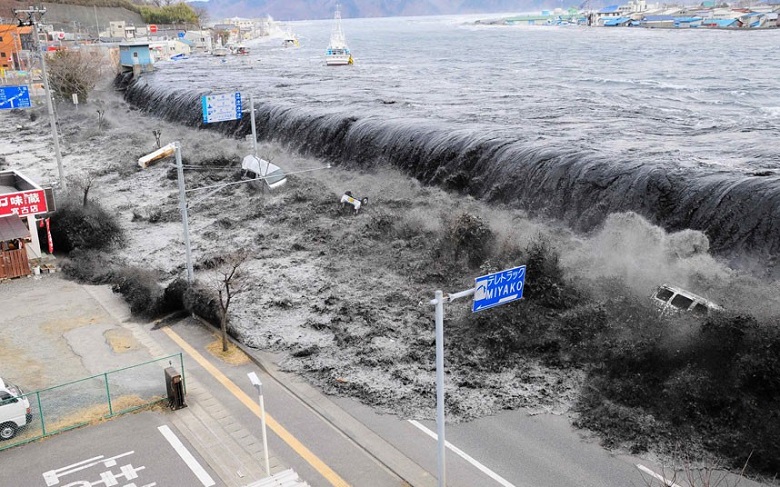
Japanese city affected by a tsunami

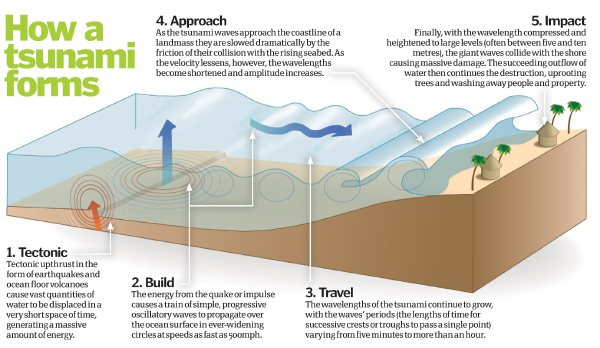
A tsunami is a wave or series of waves in the ocean that are extremely large and fast. These waves can travel across the oceans at phenomenal speeds, up to 550 miles per hour. This is roughly the speed of a jet. When they are far out in the ocean, they are barely noticeable. However, once they begin to crest at a shoreline, they can become very destructive.

How do tsunamis form at shorelines? This happens because tsunami speed is directly related to the depth of water. As a tsunami approaches the shore, the speed of the wave slows down. At the same time, the total energy of the wave remains the same. This causes the height of the wave to grow as the top of the tsunami wave travels faster than the bottom. So, while the wave may be completely imperceptible in the deep waters of the ocean, the destructive energy of the wave releases on shore as it lands.

The energy released in a large tsunami is astounding. It is nearly impossible to calculate precisely. Nonetheless, it’s estimated that the energy released in the 2011 tsunami that devastated Japan was equivalent to nearly 100 nuclear bombs the size of those that were dropped on Nagasaki and Hiroshima. This is an ironic form of measurement since the tsunami caused a crisis at a nuclear power plant in the Fukushima Prefecture that is still devastating the environment today.

How Do Tsunamis Form?

The answer to the question of how do tsunamis form lies in understanding the different forces of nature that can cause them. Tsunamis form due to an enormous amount of water displacement. Most people think that tsunamis only form from earthquakes. However, there are actually several things that can cause a tsunami to form. Anything that disturbs a large volume of water is capable of generating a destructive tsunami. The possible precursors of tsunamis besides earthquakes include:

  • Volcanic eruptions, both above ground and underwater.
  • Above ground rockslides or landslides.
  • Underwater rockslides or landslides.
  • Asteroid strikes.

In each of these cases, a large volume of water is either thrust up or dropped down. This causes all of the water to create a series of waves called a wave train. The waves in this wave train can be up to 60 miles long and as far apart as an entire hour. Because there is often little or nothing in the ocean to interfere with the path of these waves or absorb the energy, they can travel across the entire planet at breathtaking speeds with very little loss of energy. A tsunami wave train can travel across the entire Pacific Ocean in less than one day.

How Do Tsunamis Form

Historical Tsunamis

Contrary to popular belief, tsunamis can form in a lake, as well as in an ocean. How do tsunamis form in lakes? Landslides often are the cause. In 563 AD, a massive tsunami occurred in Lake Geneva for this very reason. The landslide was so massive that it caused the resulting wave to race across the lake and inundate the city walls of Geneva. The waves swept over the tops and drowned those who were unable to escape the wall of water. This is one of the more common answers to the question of how do tsunamis form from forces other than earthquakes.

This landslide was triggered by an accumulation of sediment that reached a point so massive it collapsed under its own weight. Aside from meteor impacts, these landslide-triggered tsunamis can be the most violent that nature produces. They can cause tsunamis that dwarf the Boxing Day tsunami in height, if not destructive power over a widespread path.

On July 9, 1958, in Lituya Bay, Alaska, a rockslide – this one actually was caused by a large earthquake – generated a tsunami with a run-up height of over 1700 feet. The force of this tsunami destroyed all of the vegetation in its path. But the loss of life in this tsunami was minimal because it occurred in such a sparsely populated area. In fact, only five people total died that day. A later tsunami in Alaska in 1964 took 119 lives and inflicted over $400 million dollars in damage.

Where Do Tsunamis Occur Most Often?

tsunami risk map

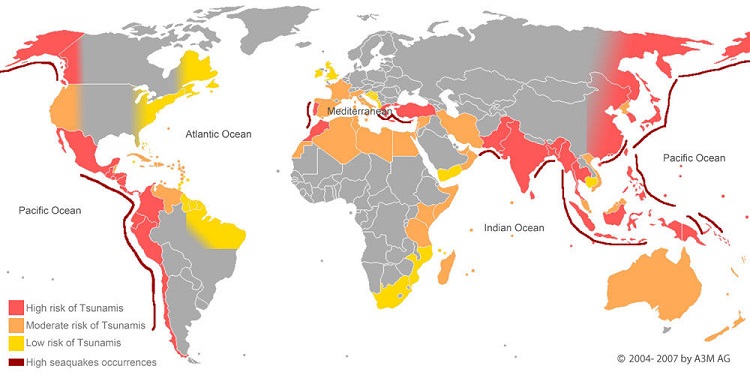
Tsunamis can occur along any coastline or in any large body of water. The Pacific Ocean is the place where most of the world’s tsunamis form. This is because subduction zones are so common there. How do tsunamis form along subduction zones? Subduction zones are fault lines that cause one tectonic plate to slide under another.

These can trigger particularly violent mega – thrust earthquakes that consist of an upward or downward motion instead of a horizontal wave. This motion almost always produces a wave when it occurs underwater. Nonetheless, it is only strong enough to produce noticeable tsunamis part of the time. Those areas along the Pacific that are most likely to see tsunamis are Alaska, Chile, the Aleutian Islands, Japan and the Philippines.

While tsunamis do occur in the above-mentioned areas most often, they have also occurred in the Atlantic Ocean, Indian Ocean, Mediterranean Sea and elsewhere. So if you live along a shoreline, it is best to fully understand the answer to the question of how do tsunamis form and understand the risk of tsunamis in the area. If tsunamis have occurred in the past, they can and most likely will occur again. Be aware of escape routes and possible warning signs of an approaching tsunami.

Some signs of a tsunami are:

  • An earthquake. Very often, local geological services will forecast the possibility of a tsunami and likely strike zones when an earthquake occurs under water or near the shore. Pay heed to these warnings.
  • Active buoys in the tsunami warning system. These buoys can be activated even when underwater earthquakes are not noticeable to those onshore. They are particularly useful to sailors. They can receive warning in time to escape shorelines where the destructive force of the tsunami occurs and move out to the open sea.
  • A very sudden and noticeable rise or fall in the water level. Tsunamis are often preceded by this phenomenon as the energy of the wave begins to displace the water of the coastline. It is estimated that this phenomenon can precede a tsunami by as much as five minutes. This gives the shore bound time to escape to higher ground. Tragically, many of those who were inundated by the Boxing Day tsunami did not know this sign. They went even closer to the shore to watch as the water receded. This is why knowing the warning signs of a tsunami and understanding how tsunamis form is so important.

Finally, make sure that you always have an emergency kit. It should contain enough food, medical supplies and fresh water to last from three days to a week. This is because tsunamis can wipe out local infrastructure and power and will likely destroy local water delivery systems. Heeding these warning signs and being properly prepared will help you to be a survivor and not a victim of this powerful force of nature.

IMAGE SOURCE: 1, 2, 3

  • « Previous Page
  • 1
  • 2
  • 3
  • 4
  • 5
  • 6
  • 7
  • Next Page »

5 Safety Tips You Need To Know If You Live Near A Nuclear Power Plant

image source: pixabay.com When purchasing a home, there a lot of things to consider. What area of the United States do you want to live? Do you want to be in the country or in the city? Are you going to rent or own, and will it be an apartment or a house? If you […]

Tornado Warning VS Tornado Watch: What You Need To Know

When it comes to severe weather, nothing is as devastating as a tornado when you consider the inch to inch devastation. Tornados often possess stronger winds than hurricanes, and due to the cyclone shape of a tornado, it increases the damage potential. Tornados are also especially dangerous if you are in its path. A single […]

Long Term Water Storage: The Ultimate Guide

While you hope that a calamity like a water shortage or other emergency will never befall in your lifetime, it is always important to be prepared for the worst while hoping for the best. One of the most important aspects of emergency preparedness is ensuring you have a sufficient stockpile of water to get you […]

10 Best Filter Water Bottle Brands To Use During Emergencies

If there is one thing that all hikers and outdoor enthusiasts have in common, it’s that they all agree you should never blindly drink out of a natural water source. That’s because the unfiltered water, although fresh and natural, contains harmful bacteria and waterborne parasites that would likely go undetected by taste alone. With a […]

14 Deadliest Natural Disasters of All Time

What are the deadliest natural disasters of all time by death toll? Which type of deadliest natural disasters has the greatest death count? More importantly, what are some ways the population was affected by those disasters? Were there things that people did to worsen or better the effects of mother nature angrily smashing her surroundings? […]

4 Frostbite Symptoms And How To Treat Them

With the onset of winter comes the risk of getting frostbite. With all of the outdoor recreation that’s available to us in the winter, it is important to learn how to protect ourselves. Knowing the signs of frostbite in the early stages can help you to avoid permanent damage to your skin and underlying tissues. […]

Fire Escape Plan for Your Family: Our Complete Guide

No one ever thinks a tragedy will happen to them. We see events on the news all the time such as accidents, home invasions, and house fires. We rarely plan for these things because we never think that we will be in such a situation. If you do one thing this coming year, whether you have […]

10 Tips for Living Through Power Outages

Most of us don’t think of power outages until we’re searching for flashlights or candles in the dark. Some think the light on their cellphone will be good enough to make it through power outages. That might work if power outages happen only when your phone is already fully charged. But, what about being prepared […]

How To Tell If A Snake Is Poisonous: Your Ultimate Guide

image source: Pixabay Have you ever been startled by a snake in your yard? Snakes are among the most misunderstood and feared animals on the planet, mainly because of the poisonous and potentially deadly bite a snake can inflict on its target. The truth, however, is that most snakes in the United States are non-venomous and […]

Copyright © 2026 ·Outreach Pro · Genesis Framework by StudioPress · WordPress · Log in